Identify and observe
Review agent identities, behaviour and configured trust signals.
 UAE · AI integration
AI agent security & governance

Apply policies to supported AI agent actions and keep the control plane, decisions and audit evidence inside your network.
Identify agents, inspect sensitive data, govern supported model and tool calls, and retain the reason behind each verdict. Sovern governs agents; Enterprise provides specialist business AI. They can work together.
Customer on-premise. Offline semantic checks use a local model endpoint.
WHAT IT BRINGS TO YOUR TEAM
Review agent identities, behaviour and configured trust signals.
Run sensitive-data and deterministic checks within your environment.
Allow, sanitise or block through the selected integration.
Retain verdicts, matched policies and operational context.
CUSTOMERS & PRIORITY USE CASES
01 / Finance, healthcare administration and legal operations
Detect and mask configured personal data or secrets locally before governed model-based evaluation. Review the post-sanitisation evidence.
What to measure: Detection and masking quality, false positives and data-flow checks.
02 / Enterprise AI platform teams
Restrict supported tool, MCP, database and shell actions to the operations each workflow is authorised to perform.
What to measure: Blocked forbidden actions, permitted-action success and bypass tests.
03 / Teams connecting agents to untrusted content
Test governed inputs and actions against deterministic rules and, where configured, a local semantic evaluator.
What to measure: Attack-test outcomes, false blocks and escalation handling.
04 / Risk, compliance and internal audit
Trace an agent request to its policy verdict and the rule that fired. Export supporting records for the organisation’s own review.
What to measure: Trace completeness, reviewer effort and policy-change history.
05 / AI operations and service owners
Observe model use, repeated calls and changes in behaviour. Review anomalous patterns and configured limits before extending agent access.
What to measure: Alert quality, unusual-loop detection and response time.
06 / Finance and engineering operations
Apply configured rules before supported financial actions, destructive queries or shell commands are dispatched. Retain the verdict for investigation.
What to measure: Disallowed-action blocks, approval coverage and exception resolution.
Sovern governs the agents carrying out these workflows. Enforcement, discovery and evidence coverage depend on the selected integration and configured policies.
Explore more use casesSEE THE WORKFLOW
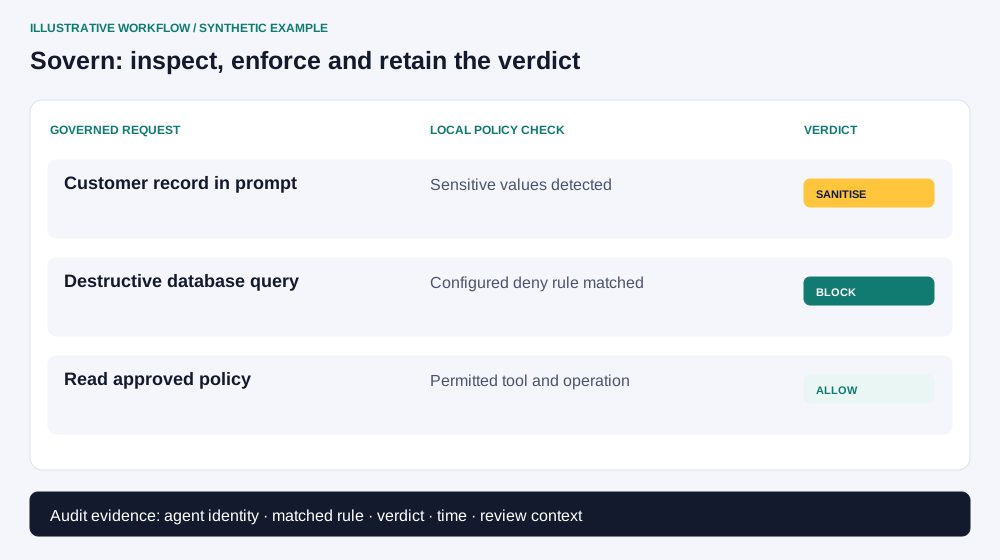
Associate the governed call with its agent and execution context.
Run deterministic rules and sensitive-data handling inside the customer environment.
Allow, sanitise or block according to the configured rule and supported call path.
Record the verdict, matched policy and relevant context for the operator.
BEFORE WE START
Customer on-premise. Offline semantic checks use a local model endpoint.
Deployment, licensing and support are agreed for the environment. Local model checks use customer compute without external model-token/API charges.
Enforcement and discovery coverage depend on integration. Fully offline operation requires local models and internal dependencies; external SaaS connectors need connectivity. Audit evidence supports review and does not establish certification.
Adapted from EgisAI product and self-hosting materials reviewed 23 October 2026. Offline semantic checks require a local model endpoint. External SaaS connectors and public model APIs require connectivity. Features vary by integration and package; no supplier certification is claimed for appana.
Tell us about your team, the task and the systems involved. We’ll work through the fit and the next step with you.
Talk to us about ACI Sovern